

What if the most effective way to lower your 2026 turnover rate by 73% wasn’t a salary bump, but a three-day escape to a quiet, historic ranch? You’ve likely felt the quiet strain of remote work; the digital fatigue, the silos between departments, and the creeping sense of burnout that no amount of video calls can fix. It’s a common challenge for the 91% of companies now operating with remote or hybrid teams. Leadership often views an offsite as a luxury perk, yet you know that building a resilient culture requires a tangible sense of place and connection. Learning how to justify a company retreat is about shifting the conversation from a simple vacation to a strategic necessity for the modern workplace.
We’ll help you transform this perceived expense into a high-ROI investment that leadership cannot ignore. You’ll learn a formal justification framework that connects your setting directly to your strategy, ensuring every moment of reflection serves a clear business purpose. From tracking productivity metrics to leveraging 2026 tax regulations, this guide provides the tools to build a case rooted in both data and human renewal. We’ll explore how a well-timed retreat acts as a laboratory for innovation, turning a peaceful escape into your team’s most productive week of the year.
Key Takeaways
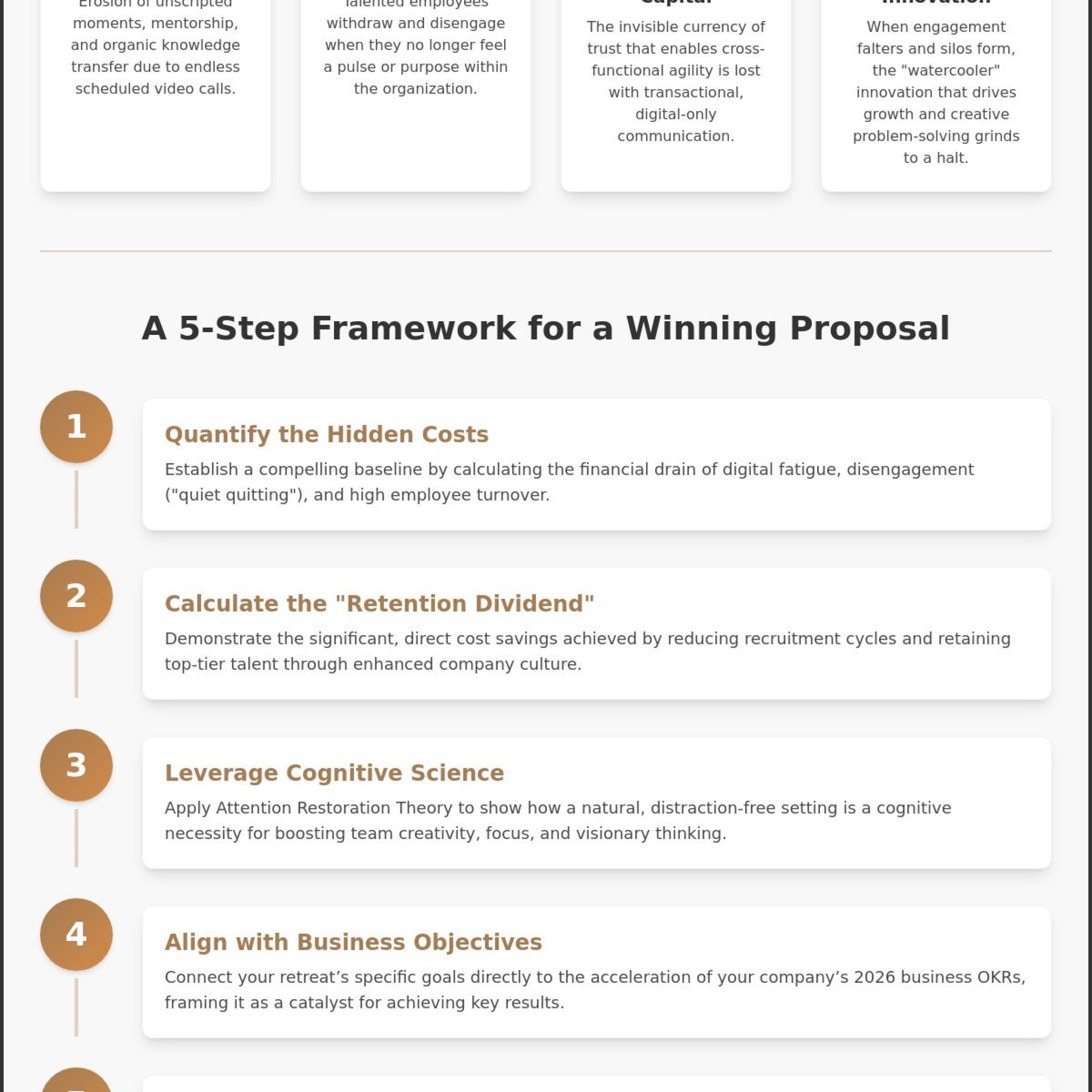
- Quantify the hidden financial drain of digital fatigue and “quiet quitting” to establish a compelling baseline for your strategic proposal.
- Discover how to justify a company retreat by calculating the “Retention Dividend,” which measures the significant cost savings of reduced recruitment cycles.
- Apply Attention Restoration Theory to demonstrate how a natural setting serves as a cognitive necessity for boosting team creativity and focus.
- Master a structured 5-step framework that aligns your retreat’s specific objectives with the immediate acceleration of your 2026 business OKRs.
- Learn to position a boutique guest ranch as a strategic sanctuary where a “gracious host” approach removes logistical friction for leadership teams.
The Hidden Cost of the Status Quo: Why Your Current Workplace May Be Stalling Growth
In 2026, the true cost of a stagnant workforce is rarely found on a balance sheet. It’s hidden in the friction of disjointed digital notifications and the quiet withdrawal of talented employees who no longer feel a pulse within the organization. With 27% of full-time employees working fully remotely and 52% in a hybrid model, the “status quo” has become a dangerous gamble. When engagement falters, innovation stalls. The financial impact of high turnover begins to drain your resources long before the resignation letters arrive. Considering that companies with strong team bonding strategies see a 73% decrease in employee turnover, the stakes are remarkably high. This is precisely how to justify a company retreat; you aren’t asking for a luxury, you’re proposing a necessary intervention against organizational decay.
Digital fatigue is more than just tired eyes. It’s the erosion of the unscripted moments where mentorship once thrived. In a world of scheduled video calls, the organic transfer of knowledge has been replaced by transactional tasks. Without a dedicated space for Strategic Renewal, your team risks becoming a collection of isolated individuals rather than a cohesive unit. A retreat offers a chance to pause the digital noise and reconnect with the core mission in a setting that inspires rather than exhausts. It’s about moving from a culture of survival to one of shared purpose.
The Erosion of Social Capital
Social capital is the invisible currency of your business. It’s the trust that allows a marketing lead to pivot quickly based on a developer’s casual suggestion. Transactional communication kills this “watercooler” innovation. High-stakes decision making requires a foundation of face-to-face trust that cannot be forged through a screen. Organizing a team-building retreat allows your staff to rebuild this measurable business asset. It creates the cross-functional agility needed for the fast-paced market of 2026. When people trust each other, they move faster and solve problems with greater creativity.
Addressing the “Meeting Fatigue” Dilemma
Most leaders fear that an offsite is simply a “carpeted version of the office” with a higher price tag. They picture multi-day meetings in sterile, fluorescent-lit conference rooms. However, an immersive experience is the opposite of a marathon meeting. By physically leaving the office grid, a psychological shift occurs. This distance enables higher-level visionary thinking. When you remove the daily logistical friction and step into a sanctuary of quiet reflection, your team can finally move from tactical survival to long-term strategy. Understanding how to justify a company retreat means proving that a change of scenery is the catalyst for your next major breakthrough.
Measuring the Tangible ROI of Offsite Collaboration
Proving the value of an offsite often requires moving beyond the abstract and into the realm of hard data. While the emotional benefits of a shared sunset or a fireside conversation are undeniable, leadership demands a fiscal narrative. In fact, there are three reasons to make a company retreat a priority that center on workforce improvement and leveraging organizational impact. When you calculate the “Innovation Speed” of a team, you see that problems which might linger for months in a crowded inbox are often solved in a single afternoon of focused, face-to-face collaboration. This condensed time isn’t just efficient; it’s transformative for your 2026 bottom line. Learning how to justify a company retreat means demonstrating that these moments of connection are the fuel for your next major growth cycle.
The Retention Dividend and Talent Acquisition
Recruiting top-tier talent in a competitive market requires more than a salary; it requires a compelling brand story. A high-quality retreat serves as a visible commitment to your team’s growth, acting as a powerful magnet for candidates who value culture over corporate coldness. High-trust environments are directly correlated with employee longevity, creating a “Retention Dividend” that saves your organization the massive costs associated with recruitment and training. Cultural ROI is the long-term value of shared heritage and story that binds a team together long after the suitcases are unpacked. By investing in these shared memories, you’re building a resilient workforce that stays engaged through market fluctuations.
Accelerating Strategic Alignment
Retreats provide the sanctuary for “uninterrupted deep work” necessary to tackle complex OKRs (Objectives and Key Results). When teams step away from daily logistics, they gain the clarity needed to align with the company mission. These shared experiences also create a communication shorthand; a way of understanding each other’s nuances that makes post-retreat digital work significantly faster and more accurate. This alignment is vital for 2026 market agility, where teams must pivot quickly without losing sight of their primary goals. If you’re seeking a space where history and modern hospitality meet to foster this level of focus, consider exploring secluded corporate retreats in Tucson that offer the privacy your leadership team requires.
The true measure of a retreat’s success is found in the weeks that follow. By establishing a shared mission clarity during the offsite, you reduce the friction of misunderstanding that often plagues remote teams. This clarity ensures that every team member is moving in the same direction, accelerating your path to reaching key business milestones. When you can point to faster decision-making and a more unified brand voice, the business case for your next retreat becomes self-evident.
Why Environment Dictates Outcome: The Case for a Change of Scenery
The physical space your team occupies acts as an invisible architect for their thoughts. While many leaders assume that any quiet room will suffice for a strategy session, the environment itself often determines the depth of the resulting conversation. A generic hotel ballroom, with its fluorescent lighting and windowless walls, is frequently little more than a carpeted version of the office. It lacks the soul required to spark genuine innovation. To understand how to justify a company retreat, one must look toward Attention Restoration Theory. This psychological framework suggests that natural, historically rich settings allow the brain to recover from the “directed attention fatigue” caused by urban environments and digital screens. By choosing a sanctuary that offers “soft fascination,” such as a desert vista or a historic ranch, you provide the cognitive space necessary for your team to solve complex problems.
Psychological safety is another critical byproduct of a carefully selected setting. In a private, exclusive-use venue, the external world falls away. This creates a “closed container” where leadership can engage in honest, high-stakes dialogue without the fear of being overheard by strangers in a lobby. A sense of place, rooted in heritage and local culture, grounds a team in a larger purpose. It reminds them that their work exists within a broader story of preservation and quality, moving them beyond the immediate pressure of the quarterly report.
Office vs. Retreat: A Functional Comparison
The difference between “Office Brain” and “Retreat Brain” is the difference between being reactive and being expansive. In the office, your team is trapped in a tactical cycle, chasing the dopamine of a cleared inbox. A secluded sanctuary removes these operational distractions, allowing for a strategic shift. Privacy is a prerequisite for authentic leadership development. When you remove the noise of daily operations, you enable the quiet reflection required for visionary thinking. This transition from a reactive state to a creative one is the primary functional benefit of a well-planned offsite.
The Impact of “Gracious Hospitality” on Team Morale
There is a profound psychological difference between being “housed” and being “hosted.” When employees are welcomed into a space that reflects a “gracious host” philosophy, they feel a deep sense of being valued. High-quality accommodations and thoughtful attention to detail send a clear message: “Your work is worth this investment.” This investment in comfort is not an indulgence; it is a catalyst for morale. Choosing a boutique destination rather than a corporate chain reinforces your commitment to excellence. You can learn more about Why a Private Villa Beats a Hotel for Your Next Escape to see how these intimate settings foster a unique sense of belonging. When a team feels cared for, they are more likely to care deeply about the strategic goals they are tasked with achieving.
A 5-Step Framework for Presenting Your Retreat Proposal
Moving from the conceptual “why” to the logistical “how” requires a structured approach that speaks the language of leadership. When you prepare your presentation, you must move beyond the idea of a simple getaway and frame the event as a tactical solution to existing organizational friction. Guiding your executives through how to justify a company retreat is most effective when you use a formal framework that balances human renewal with fiscal responsibility. This process ensures that the retreat is seen not as a drain on resources, but as a strategic lever for 2026 growth. By following a clear, five-step path, you can transform a vague request into a compelling business case that is difficult to ignore.
Step 1 & 2: Building the Foundation
Success begins with an honest audit of your team’s current pain points. Are you seeing the 46% of workers who feel isolated in remote settings? Is cross-departmental innovation stalling? Identify your “Burning Platform,” the specific, urgent business challenge that the status quo cannot solve. Once this is clear, draft Success Metrics that align with your existing company KPIs. For instance, if your goal is to reduce the turnover rates that plague 91% of remote-first companies, your metric might be a 20% increase in internal NPS scores post-retreat. You might open your proposal with this value statement: “To accelerate our 2026 OKRs and bridge the communication gaps in our hybrid model, we propose a strategic offsite designed to foster high-stakes trust and collective problem-solving.”
Step 3: Present a Curated Environment
The venue you choose is the silent facilitator of your objectives. You must articulate why a specific setting is required for your specific goals. If you need deep, visionary thinking, explain that a secluded sanctuary is necessary to remove the “Office Brain” distractions discussed earlier. This is the moment to show that you have researched The Ultimate Guide to Corporate Retreat Venues and selected a location that mirrors the quality and heritage of your own brand. A curated environment proves that you are planning for impact, not just attendance.
Step 4 & 5: Closing the Deal
The final hurdle is proving that the ROI lives on long after the team returns home. Outline a Sustainment Plan that details how retreat takeaways will be embedded into daily digital workflows. This might include new communication protocols or a monthly “innovation hour” inspired by offsite workshops. Finally, provide a transparent Cost-to-Value Analysis. Frame the budget as “reallocated operational funds” by highlighting the savings found in reduced recruitment costs and increased productivity. When you demonstrate that the cost of a retreat is significantly lower than the cost of losing a single high-performing director, the proposal becomes a logical necessity. If you are ready to move from planning to action, you can reserve your corporate retreat venue in Tucson to secure your dates for the coming year.
The Solana Spanish Villas Approach: A Sanctuary for Strategic Renewal
Solana Spanish Villas isn’t just a place to stay; it’s a dedicated partner in your team’s evolution. We understand that the “Strategic Renewal” required for 2026 demands more than a standard conference room. It requires an environment that honors the weight of your decisions. Our boutique destination is designed specifically for deep reflection and high-level strategy, removing the logistical friction that often plagues corporate events. By adopting a “gracious host” philosophy, we ensure that every detail, from the atmospheric surroundings to the seamless service, allows your leaders to focus entirely on the future. When considering how to justify a company retreat, selecting a venue that actively facilitates productivity becomes your most persuasive piece of evidence.
Our property strikes a sophisticated balance between historical reverence and modern hospitality. We move away from corporate coldness toward an intimate, boutique-style narrative that makes every team member feel valued. This sense of being “hosted” rather than just “housed” is what transforms a simple meeting into a transformative experience. By providing a setting that emphasizes comfort and heritage, we help you send a clear message about the value you place on your team’s work and their collective well-being.
Privacy as a Productivity Tool
Exclusive use of a property is not a luxury; it’s a prerequisite for the high-stakes trust required in executive offsites. At Solana Spanish Villas, the external world stays at the gate. This total privacy creates a secure container for confidential discussions, allowing for a level of honesty that is impossible in public resorts or busy hotels. The tranquil desert setting, with its expansive horizons and quiet stillness, acts as a natural catalyst for innovation. This environment allows your team to shed the “Office Brain” and embrace the expansive thinking needed for long-term strategic alignment. You can explore our private properties and booking options to see how we prioritize your team’s seclusion.
Heritage and Modern Hospitality
Our property offers a unique blend of Western heritage and modern, sophisticated comfort. This rich history provides a grounding element for corporate storytelling, helping your team connect their current mission to a legacy of craftsmanship and resilience. While the architecture evokes a sense of timelessness and nostalgia, our villas are equipped with every modern amenity necessary for professional excellence. High-speed connectivity and refined comforts ensure that your strategic needs are met without compromise. We invite you to book a consultation for your next offsite and discover how our sanctuary can become the foundation for your team’s most significant breakthrough. This is how to justify a company retreat: by choosing a partner that values your success as much as you do.
Securing Your Team’s Future Through Strategic Renewal
A corporate offsite is no longer an optional perk; it’s a vital mechanism for restoring the social capital that digital fatigue erodes. By stepping away from the daily grind, your team moves from tactical survival to the visionary thinking required for your 2026 goals. You now have the framework to prove that the right environment acts as a silent facilitator, turning a simple meeting into a laboratory for innovation. Mastering how to justify a company retreat allows you to present a case that leadership cannot ignore, grounded in the tangible dividends of employee retention and mission clarity.
Our historic guest ranch offers a sophisticated blend of Red Dot-level attention to detail and total privacy. With exclusive-use venues and expert support for your offsite logistics, we provide more than just a setting; we provide a sanctuary for growth. It’s time to move beyond the screen and rediscover the power of face-to-face connection in a place that honors your team’s heritage. Explore our private villas and start planning your high-impact retreat today. We look forward to being your gracious host for your next great breakthrough.
Frequently Asked Questions
Is a company retreat considered a taxable benefit for employees?
Company retreats are generally not considered taxable benefits if they serve a clear and documented business purpose. Under 2026 IRS regulations, these gatherings are tax-deductible when they’re deemed “ordinary and necessary” expenses for your operations. It’s important to remember that while the core travel and lodging are often covered, business meals are typically only 50% deductible, and purely recreational activities may not qualify for deduction.
How far in advance should we plan a corporate retreat to ensure the best ROI?
You should ideally begin your planning process 6 to 9 months before your desired dates. This lead time ensures you can secure exclusive-use venues that offer the privacy and tranquility required for deep strategic work. Early preparation also allows you to weave the retreat’s objectives into your upcoming quarterly OKRs, ensuring the investment aligns perfectly with your 2026 business cycle.
Can a small team justify the cost of a luxury retreat venue?
Small teams often have the strongest case for a boutique venue because they rely most heavily on high-stakes trust and cross-functional agility. Understanding how to justify a company retreat for a tight-knit group involves comparing the venue cost to the massive expense of losing a single key director. A peaceful, historic setting acts as a catalyst for the “Retention Dividend,” protecting your most valuable human assets.
What is the ideal duration for a company retreat to balance work and renewal?
A stay of 3 days and 2 nights is the most effective timeframe for balancing professional output with personal renewal. This duration allows for an initial evening of decompression, a full day dedicated to expansive strategic thinking, and a final morning for tactical alignment. It’s the perfect window to trigger a psychological shift without causing a significant backlog in your team’s daily operations.
How do we handle employees who are skeptical or resistant to retreats?
Address resistance by involving your team in the objective-setting phase long before you depart. When staff see that the retreat is a direct response to their pain points, such as digital fatigue or siloed communication, they view the event as a solution rather than a burden. Emphasizing our “gracious host” philosophy helps reassure them that the experience will be one of comfort and respect.
What happens if a retreat doesn’t meet its stated objectives?
Perceived setbacks should be treated as essential data for your long-term sustainment plan. If specific goals aren’t met, it often highlights deeper organizational silos or a need for more robust post-retreat integration. Use the experience to refine your 5-step framework, ensuring that the next sanctuary you visit is even more aligned with your team’s evolving cultural and strategic needs.
How do we measure the ROI of “soft” outcomes like team morale?
You can quantify morale through pre- and post-retreat sentiment surveys and internal NPS tracking. Another effective method for how to justify a company retreat is monitoring “Innovation Speed,” or the rate at which new ideas move from conception to execution following your return. These metrics transform the feeling of renewal into a tangible business asset that stakeholders can easily appreciate.
What are the most common mistakes when trying to justify a retreat budget?
The most frequent error is positioning the retreat as a reward for past wins rather than a laboratory for future growth. Many planners also fail to mention the “Retention Dividend” or the high cost of the status quo. Avoid treating your venue as a mere backdrop; instead, explain how a setting rich in heritage and tranquility is a functional requirement for cognitive recovery and focus.
0 Comment