


Did you know that global employee engagement fell to just 20% in 2025? This decline represents nearly $10 trillion in lost productivity, making the health of your corporate culture more vital than ever. You have likely experienced that golden moment at the end of a team gathering where the air feels charged with new ideas and a renewed spirit. Yet, many leaders struggle with how to measure employee engagement after a retreat once the tranquility of the event fades into the Monday morning reality. It’s often a challenge to quantify the intangible beauty of a shared experience, especially when you are looking for more than just “better vibes” to show your stakeholders.
You deserve a more refined way to prove the value of your investment. This guide offers a methodical framework for capturing the true impact of your time away, moving past simple anecdotes toward actionable data. We will share a clear roadmap for post-event evaluation that balances the immediate pulse of your team with long-term cultural shifts. You’ll discover how to translate a thoughtful escape into improved retention and a more productive, connected workforce that carries the spirit of the retreat back into the daily rhythm of business.
Key Takeaways
- Understand why evaluating the success of your gathering is a vital leadership responsibility that distinguishes a fleeting “glow” from lasting cultural transformation.
- Master the 24-hour rule for sentiment capture and learn how to measure employee engagement after a retreat using a sophisticated blend of data and qualitative storytelling.
- Discover the “gracious host” method for facilitating natural, vulnerable conversations that reveal the deep human impact of your team’s shared experience.
- Implement a methodical 30-60-90 day framework to track concrete shifts in productivity and correlate your retreat with improved employee retention.
- Learn how to turn post-event insights into a continuous feedback loop that ensures every future corporate gathering is more impactful than the last.
The Strategic Value of Measuring Retreat Success
A corporate retreat is more than a brief departure from the boardroom; it’s a significant investment in your most valuable asset. Leaders often view these events through the lens of hospitality and morale, yet there is a profound fiduciary responsibility involved. You are essentially acting as a steward of company culture, and ensuring a return on that investment is vital for long-term organizational health. While it’s easy to enjoy the immediate “Post-Retreat Glow,” true success lies in sustainable cultural transformation. Moving beyond surface-level happiness allows you to understand the deep-rooted sentiment of your workforce. By studying the foundational principles of employee engagement, you can better understand how to measure employee engagement after a retreat and transform a pleasant weekend into a strategic pivot point.
Refining this data-driven approach helps you plan future executive offsites with precision. Instead of guessing what worked, you rely on concrete insights to shape the next chapter of your team’s story. When you look toward the horizon for your next gathering, selecting a setting like our refined Tucson villas can provide the perfect backdrop for these deep cultural shifts.
Defining Success Metrics for Your Team
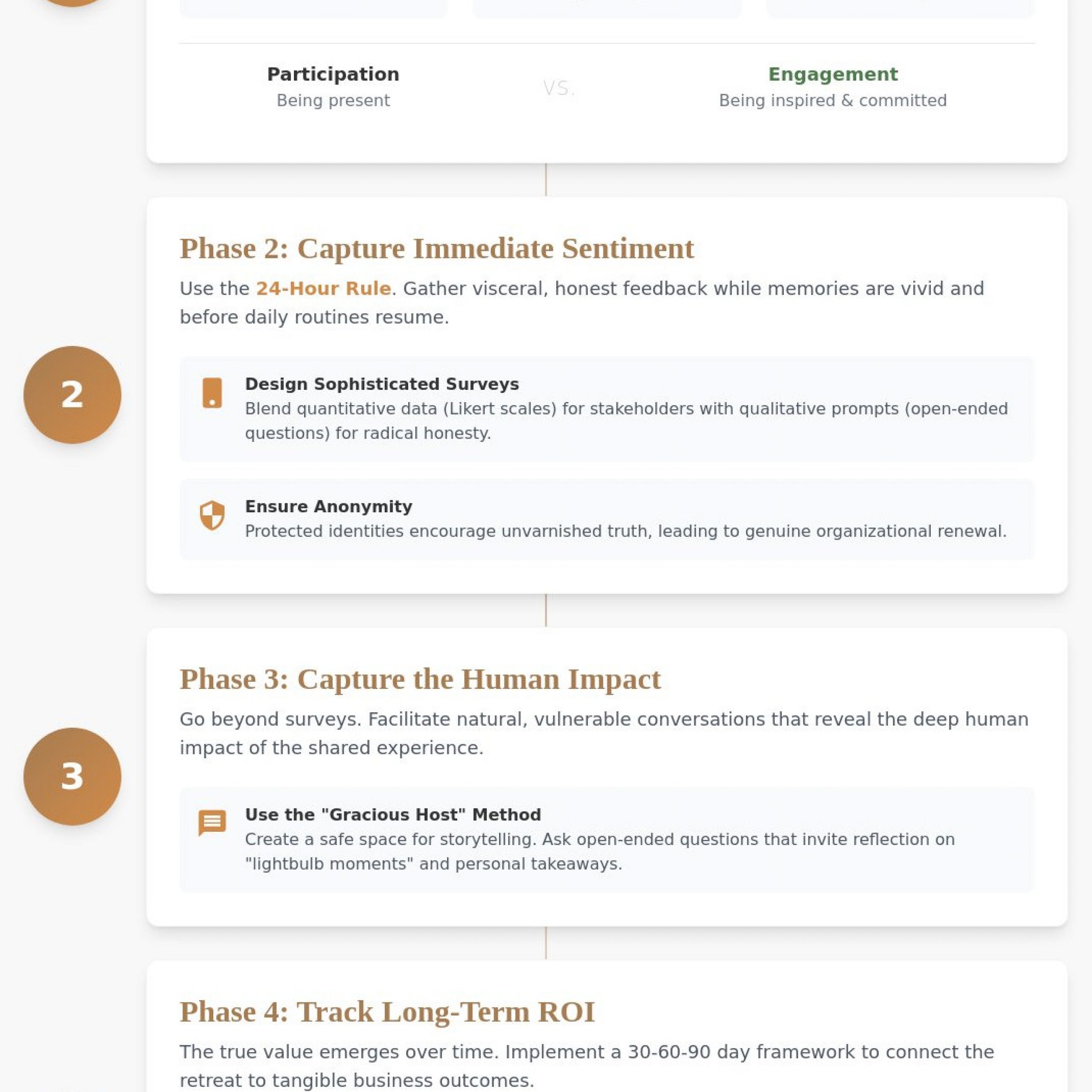
Before the first suitcase is packed, you must establish a baseline. Without a “before” snapshot, your “after” data lacks context. You should categorize your goals clearly. Are you seeking social cohesion, strategic alignment, or specific skill development? It’s also crucial to distinguish between participation and true engagement. A team member might attend every workshop and dinner, but their emotional connection to the mission is what truly defines the success of the event. Participation is merely about being present; engagement is about being inspired and committed to the collective vision.
The Cost of the ‘Dark’ Retreat
Hosting a retreat without a structured feedback loop is a missed opportunity that often leads to a “dark” retreat. When leaders fail to follow up, it can breed skepticism among employees, often resulting in the dreaded “forced fun” narrative. This disconnect happens when the energy of the event isn’t anchored back into the Monday morning reality. Closing the loop with attendees isn’t just a logistical step; it’s a psychological necessity. It signals that their voices were heard and that the time spent in reflection was valued by the organization. Without this intentional follow-up, you risk losing the very momentum you worked so hard to build during your time away.
Designing Effective Post-Retreat Engagement Surveys
The transition from a peaceful retreat back to the office is a delicate moment. To understand how to measure employee engagement after a retreat, you must act while the memories are still vivid. We recommend the 24-hour rule. Capturing sentiment within a day of returning ensures that the feedback is visceral and honest, before the routine of daily tasks begins to cloud the experience. This immediate window is when your team is most likely to share the “lightbulb moments” that occurred during a sunset walk or a collaborative workshop. It’s a time of high clarity that provides the most authentic data.
A sophisticated survey strikes a balance between structured data and narrative reflection. While Likert-scale questions provide the metrics your stakeholders require, open-ended prompts allow for the radical honesty that drives growth. Ensuring anonymity is paramount. When employees feel their identity is protected, they are far more likely to offer the kind of unvarnished truth that leads to genuine organizational renewal. Leveraging modern survey tools can streamline this process, allowing you to gather and analyze team sentiment with the same precision and care you applied to the event itself. This methodical approach to measuring employee engagement ensures no valuable insight is lost to time.
The Immediate Sentiment Pulse
Your initial survey should focus on the atmosphere and comfort of the gathering. Ask specific questions about the physical environment and the flow of activities. Did the setting foster a sense of tranquility? Capturing these feelings early helps you understand if the chosen venue truly served its purpose as a sanctuary for team building. If you are already looking for your next inspiring location, consider how the right environment, such as a refined Tucson villa, can elevate the quality of feedback you receive.
The Quantitative Framework
To provide concrete data, calculate a Net Promoter Score (NPS) specifically for the retreat by asking how likely employees are to recommend the experience to a colleague. Measure how much more aligned they feel with the company vision after the event. The ‘Engagement Lift’ metric is the percentage increase in positive sentiment compared to pre-retreat baselines. These numbers provide the structural backbone for your ROI report, proving that the retreat was a strategic success rather than just a pleasant getaway.
Qualitative Assessment: Capturing the Human Impact
While spreadsheets offer a comforting sense of order, they rarely capture the full story of team renewal. A percentage on a screen cannot replicate the warmth of a shared meal or the quiet spark of a new friendship formed during a desert sunset. To master how to measure employee engagement after a retreat, you must adopt the role of a ‘Gracious Host’ in the weeks following your return. This involves facilitating natural, unhurried conversations that allow the human impact of the experience to surface. By listening to the stories your team tells, you move beyond cold metrics into the heart of your organization’s health.
You will likely notice ‘Retreat Champions’ emerging in the office. These individuals act as stewards of the event’s energy, naturally weaving shared references into daily meetings. Their presence is a qualitative indicator of success. They bridge departmental gaps and maintain the momentum of the gathering, serving as a living bridge between the tranquility of the offsite and the demands of the workplace. Identifying these leaders is just as important as tracking survey results, as they are the ones who sustain the cultural shift long after the suitcases are unpacked.
Focus Groups and Informal Debriefs
Small group ‘coffee chats’ provide a sanctuary for honest reflection. Instead of a formal agenda, encourage storytelling. Ask your team to describe the moments that felt most impactful. You might discover that a simple, unscheduled conversation by a fire pit did more for morale than a structured workshop. It is also the ideal time to identify points of friction. Understanding what didn’t resonate allows you to refine future gatherings, ensuring each experience is more polished and personalized than the last.
Observing Team Dynamics in the Boardroom
The true test of a retreat occurs in the boardroom. Observe the frequency of cross-departmental collaboration. When silos begin to dissolve, it is often because of the social glue created during your time away. Watch for the emergence of inside jokes and shared references; these are the subtle threads that bind a team together. You should also evaluate the speed of conflict resolution. A team that has shared a peaceful escape often navigates disagreements with greater grace and efficiency, reflecting a deeper level of mutual respect and a renewed commitment to collective goals.
Tracking Long-Term ROI and Cultural Shifts
Proving the value of a corporate gathering requires patience and a methodical eye. While the immediate feedback gathered in the first 24 hours is vital, it’s only the beginning of the story. To truly understand how to measure employee engagement after a retreat, you must track the evolution of your team over months, not just days. This long-term perspective allows you to move past the temporary excitement and identify sustainable changes in how your people work together. It’s about observing the quiet, steady shifts that occur once the initial “glow” has settled into a new way of being.
Presenting this data to the C-suite requires a blend of hard numbers and cultural narrative. When you can demonstrate that a retreat wasn’t just a getaway but a catalyst for strategic alignment, securing future budgets becomes a much simpler conversation. You are providing proof that investing in shared experiences directly counters the global trend where engagement fell to just 20% in 2025. By showing how these gatherings act as a sanctuary for renewal, you position yourself as a steward of both company culture and fiscal health.
The 30-60-90 Day Milestones
We recommend a structured framework to monitor lasting change. During the first month, focus on the retention of strategic information. Are the goals set during the offsite still guiding daily decisions? By the second month, you should measure the sustained increase in team collaboration, looking for fewer silos and more cross-departmental initiatives. Finally, at the 90-day mark, evaluate the impact on core business KPIs. This is the moment to see if the renewed energy has translated into tangible innovation or a more resilient work environment.
Connecting Retreats to Core KPIs
Highly engaged teams are 18% more productive than those who feel disconnected, a statistic that becomes visible when you analyze the reduction in project bottlenecks following a retreat. You can also monitor qualitative improvements in wellbeing by correlating retreat attendance with a reduction in reported burnout symptoms during quarterly reviews. This data doesn’t just prove ROI; it helps you refine your corporate retreat venues selection process for the future. Understanding which environments fostered the most significant growth allows you to curate even more impactful experiences. When you are ready to plan your next chapter of team renewal, we invite you to reserve a sanctuary that inspires deep, lasting connection.
Creating a Feedback Loop for Future Growth
Data is only as valuable as the actions it inspires. Once you have gathered your quantitative metrics and qualitative stories, your role as a curator of culture shifts toward stewardship. The final, perhaps most essential stage in learning how to measure employee engagement after a retreat is the act of closing the loop. This process involves more than just filing a report; it requires sharing the journey’s results with the very people who lived it. When you communicate your findings back to the team, you demonstrate that their voices carry weight and that their vulnerability was not in vain. This transparency builds a foundation of trust that makes the next gathering even more impactful.
A methodical approach to feedback ensures that each subsequent event is a more polished reflection of your team’s needs. You are not just planning a trip; you are refining a tradition of renewal. By showing your staff that you have listened to their preferences regarding the pace of the day or the style of collaboration, you foster a sense of ownership over the company’s cultural evolution. This commitment to continuous improvement is what transforms a simple offsite into a cornerstone of organizational health.
Turning Data into Action
The insights gathered from your post-event surveys should directly inform the blueprint for your next escape. If the feedback suggests the schedule was too dense, you can adjust the balance between structured workshops and the “white space” needed for spontaneous connection. You might also refine your catering or lodging choices to better align with the team’s evolving tastes. Ensuring the next event venue with lodging matches these specific preferences is a tangible way to show your team that their comfort is a priority. It turns a logistical choice into a gesture of hospitality.
The Influence of a Serene Environment
The quality of the feedback you receive is often a direct reflection of the environment where the experience took place. A sterile hotel ballroom often yields sterile responses, while a private, boutique setting encourages a deeper level of openness. There is a profound psychological impact when you invite your team to escape the corporate coldness. In a sanctuary characterized by tranquility and architectural beauty, employees feel safe to share authentic reflections. This openness is vital for anyone looking at how to measure employee engagement after a retreat with true accuracy. We invite you to experience the difference a private, scenic setting for your next retreat can make, providing the peaceful atmosphere your team needs to grow, reflect, and connect.
Cultivating a Legacy of Connection
Understanding the true impact of your time away requires a delicate blend of data and narrative. By moving beyond the initial excitement and implementing a methodical 30-60-90 day framework, you ensure the seeds of strategy and culture planted during your retreat actually take root. You’ve seen that mastering how to measure employee engagement after a retreat isn’t just about spreadsheets; it’s about observing shifts in collaboration and honoring the human stories that emerge in the boardroom.
The setting you choose acts as the silent facilitator of this growth. A private, historic guest ranch provides the tranquility needed for high-quality reflection and professional breakthrough. When your team feels like honored guests in a sanctuary of heritage and comfort, their openness and commitment to the collective vision naturally deepen. We invite you to discover the perfect setting for your team’s next breakthrough at our refined Tucson villas. Our space is intentionally tailored for executive and wellness retreats, focusing on the preservation of culture and the pursuit of excellence. Your journey toward a more engaged, resilient workforce begins with a single, thoughtful choice.
Frequently Asked Questions
When is the best time to send a post-retreat engagement survey?
You should send your survey within 24 hours of the team’s return to capture visceral, unclouded sentiment. This immediate window ensures that atmospheric details and emotional breakthroughs remain fresh before the “routine fog” of the office sets in. Acting swiftly allows you to gather the most authentic reflections before the tranquil memories of the escape begin to fade into the background of daily tasks.
What are the most important questions to ask after a corporate offsite?
Focus on a blend of strategic alignment and personal connection to get a complete picture. Ask questions like “How likely are you to recommend this experience to a peer?” to establish a Net Promoter Score for the event. You should also inquire about specific moments where a team member felt a renewed sense of purpose or a breakthrough in collaboration. These prompts reveal if the event met its goals while capturing human stories.
How can I measure the ROI of a team-building retreat?
ROI is best measured through a long-term framework that tracks productivity and retention metrics. Since highly engaged teams are 18% more productive, monitor project bottlenecks and output quality in the 90 days following your gathering. When you understand how to measure employee engagement after a retreat, you can correlate the event with reduced turnover. This data provides the fiscal proof needed to justify the investment to your stakeholders.
Can a retreat really improve long-term employee retention?
Yes, retreats create the social glue necessary to combat the global decline in engagement, which hit a low of 20% in 2025. These shared experiences foster deep, relational feedback that formal office programs often lack. By providing a sanctuary for renewal, you address the primary driver of engagement: growth and learning opportunities. This sense of being valued directly translates to a more loyal and committed workforce over time.
How do I handle negative feedback about the retreat or activities?
Approach negative feedback with the perspective of a gracious host who values honesty over appearances. View critiques as essential data points for refining future gatherings rather than personal failures. Acknowledge the feedback openly with your team to show that their voices truly matter. This transparency reinforces a culture of psychological safety, turning a point of friction into an opportunity for organizational growth and better strategic alignment.
What is the difference between qualitative and quantitative engagement data?
Quantitative data provides the structural “what,” while qualitative data offers the evocative “why.” Quantitative metrics include things like Engagement Lift percentages or NPS scores that you can plot on a graph for leadership. Qualitative data captures the human impact, such as the emergence of inside jokes or a noticeable shift in how departments communicate. Both are required to tell the complete story of your team’s cultural transformation.
How often should we host retreats to maintain high engagement levels?
Most successful organizations find that an annual retreat provides a steady rhythm for cultural renewal and reflection. If your team is experiencing rapid growth or significant strategic shifts, bi-annual gatherings may be more appropriate to maintain alignment. The goal is to host these events often enough to sustain the momentum of connection without them feeling like a routine obligation. Consistency helps preserve the heritage of your culture.
Does the choice of retreat venue impact the survey results?
The environment serves as a silent facilitator that significantly influences the quality and depth of your survey results. A private, historic setting often leads to more vulnerable and authentic feedback than a standard corporate hotel. When employees feel inspired by their surroundings, they are more likely to engage deeply with the sessions and provide thoughtful reflections. Choosing a venue that emphasizes tranquility and comfort is a strategic decision that elevates the experience.
0 Comment