


Did you know that while the global corporate retreats market is projected to climb toward $73.7 billion by 2034, only 17% of companies currently have a formal system for measuring corporate retreat ROI? It’s a staggering gap for an investment that defines your team’s culture. You likely understand the pressure of justifying the cost of a heritage ranch or a boutique stay when leadership demands hard numbers. It’s difficult to quantify the quiet confidence gained during a sunset trail ride or the renewed trust built over a shared meal, especially when you lack baseline data to compare against.
We agree that the most profound shifts often happen in these tranquil, unhurried moments, but we also know that business-critical tools require validation. This guide promises to help you master the art of quantifying your offsite’s value with a data-driven framework. You’ll learn to move beyond simple feedback forms and embrace a narrative of human capital preservation that proves your retreat’s impact on the bottom line. We will walk through concrete formulas for employee retention and productivity gains, giving you a clear reporting structure that transforms your next gathering into a validated strategic victory.
Key Takeaways
- Transition from viewing offsites as mere perks to seeing them as strategic interventions designed to enhance your team’s collective efficiency.
- Secure a valid baseline by identifying key performance indicators and friction points at least thirty days before your team arrives at the ranch.
- Utilize concrete mathematical formulas for measuring corporate retreat ROI by comparing the high cost of employee turnover against the investment of your retreat.
- Capture the transformation of “soft” benefits into measurable outcomes through surveys that focus on specific behavioral commitments and managerial observations.
- Synthesize your findings into a sophisticated executive summary that uses “before and after” visualizations to prove the strategic value of your gathering.
Beyond the Happy Sheet: A Modern Framework for Corporate Retreat ROI
For too long, the success of an offsite was judged by the “happy sheet” handed out during the final breakfast. If the coffee was hot and the beds were comfortable, the event was deemed a win. We believe that a truly refined gathering deserves a more sophisticated lens. In 2026, the definition of corporate retreat ROI has evolved into the measurable gain in human capital efficiency relative to the total cost of the event. It’s a shift from viewing these gatherings as a simple “perk” to recognizing them as a strategic intervention. When you gather your team in a place of heritage and tranquility, you aren’t just hosting a trip; you’re investing in the very architecture of your organization.
Measuring corporate retreat ROI effectively requires looking past the immediate glow of a successful weekend. While 83% of companies rely on feedback forms, these only capture 20% of the actual story. A true framework uses a 180-day tracking window to see how the seeds planted in the desert or the mountains actually bloom in the office. This involves a sophisticated look at Return on Investment (ROI), specifically distinguishing between hard financial gains and the Return on Interaction, or Soft ROI. Hard ROI tracks the dollars saved or earned; Soft ROI tracks the strengthened bonds that make those dollars possible.
The Three Pillars of Retreat Value
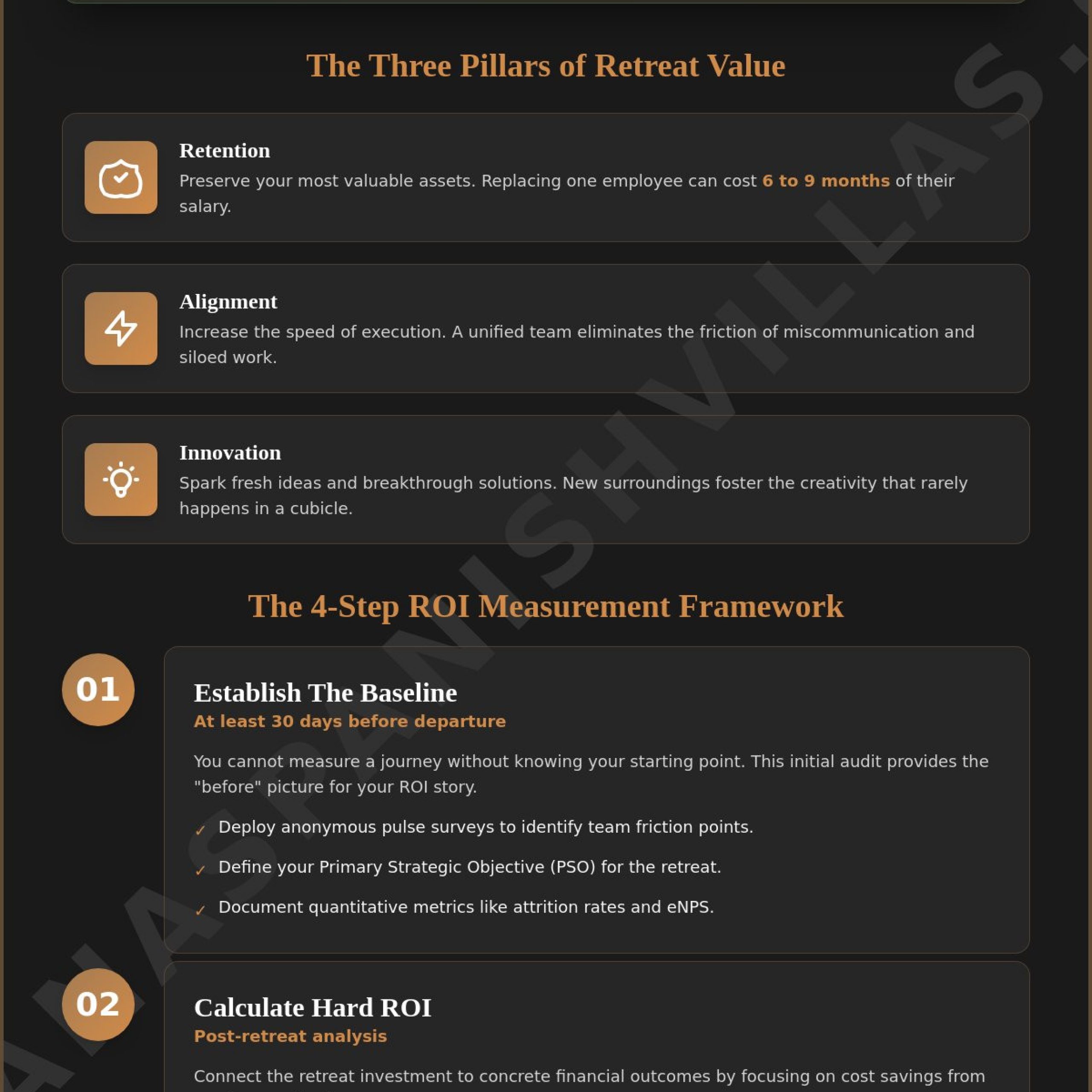
- Retention: Replacing a single employee can cost between 6 to 9 months of their salary. A well-timed retreat acts as a preservation tool for your most valuable assets.
- Alignment: The speed of execution increases when a team is unified. A strategic reset in a peaceful environment eliminates the friction of miscommunication.
- Innovation: Fresh surroundings spark fresh ideas. Breakthroughs rarely happen in a cubicle; they happen during a sunset walk or a quiet moment by the fire.
Why Traditional Event Metrics Fail Retreats
The “vacation bias” is a common hurdle for many leaders. It’s the lingering worry that if a team is enjoying a beautiful space, they aren’t being productive. We must overcome this by focusing on behavioral change rather than just satisfaction scores. Choosing refined properties at Solana Spanish Villas allows for an atmosphere of sophisticated escape while maintaining a rigorous focus on your Primary Strategic Objective. Attendance rates are merely a hygiene factor. Success is found in the delta between how your team functioned before the retreat and how they collaborate six months later. If the behavior hasn’t shifted, the “happy sheet” scores don’t matter.
The Baseline Phase: Identifying Key Performance Indicators Before Departure
A gracious host understands that the success of a gathering is determined long before the guests arrive. In the same way, the work of measuring corporate retreat ROI begins at least 30 days before your team sets foot on the property. You cannot measure a journey without knowing your starting coordinates. Establishing a “current state” baseline is much like the careful restoration of a historic villa; you must first understand the foundation before you can build something lasting and refined. This initial audit ensures that your retreat isn’t just a pleasant escape, but a calculated strategic tool.
Your first step involves deploying anonymous pulse surveys to gauge pre-existing sentiment on specific team friction points. These surveys peel back the layers of daily operations to reveal where collaboration has stalled or where communication has lost its clarity. During this phase, you must also identify your Primary Strategic Objective (PSO). Whether you’re navigating a leadership transition or a significant product pivot, the PSO acts as your north star. To capture the heart of your team’s current health, define your baseline Employee Net Promoter Score (eNPS) in a single, clear sentence to track against post-retreat shifts. This number serves as a vital pulse point for your organization’s internal culture.
Quantitative Baselines to Audit
- Current Attrition Rates: Document the turnover within the participating department over the last twelve months. Since the cost of replacing and training an employee is approximately 6 to 9 months of their salary, even a small shift here represents a massive financial win.
- Billable Efficiency: Audit average project turnaround times or billable efficiency scores to see where productivity currently sits.
- Recruitment Costs: Calculate the average spend per head for the specific roles attending the retreat to understand the stakes of retention.
Qualitative Baselines to Audit
While hard numbers provide the structure, qualitative data provides the soul. Audit self-reported levels of “psychological safety” to see how comfortable your team feels sharing bold, innovative ideas. Track the perceived clarity of the company’s 12-month vision; if your team doesn’t know where they’re going, they can’t help you get there. Finally, assign friction scores to cross-departmental collaboration. Identifying these gaps before you arrive at your corporate retreat in Tucson allows you to tailor the experience to mend those specific bonds. By the time you reach the desert, you’ll have a clear map of the transformation you intend to achieve.
Calculating Hard ROI: Retention, Recruitment Savings, and Productivity Gains
While baseline data provides the foundation, the true art of measuring corporate retreat ROI lies in translating cultural shifts into financial clarity. Leadership often views the cost per attendee as the final number; however, this perspective misses the larger expense it offsets. Consider the Retention Formula. Replacing a key employee typically costs 1.5x their annual salary when you factor in lost productivity and recruitment fees. If a retreat prevents just one or two departures within a year, the investment has already paid for itself several times over. It’s a sophisticated way to preserve your most valuable human capital while avoiding the high price of turnover.
Productivity ROI isn’t about working more hours; it’s about the acceleration of work. Strategic alignment sessions in a peaceful setting resolve the friction that slows down execution in the office. This clarity allows teams to move with a renewed sense of purpose, often shaving weeks off project timelines. Beyond internal gains, your offsite serves as a potent recruitment asset. In a competitive market, showing potential top-tier talent that your company invests in high-quality, heritage-rich experiences lowers the cost of acquisition. Finally, there is the “Innovation Premium.” Assigning a dollar value to specific intellectual property or strategic pivots generated during these sessions proves that a change of scenery is a business necessity.
The Seclusion Advantage: ROI of Private Venues
Choosing private villa rentals offers a strategic advantage that traditional hotels cannot match. Standard hotels are teeming with distraction costs; the noise of other guests and the generic atmosphere can fracture a team’s focus. In a secluded, sun-drenched environment, cortisol levels naturally drop. This physiological shift leads to better decision-making and more profound connections as the brain moves out of survival mode and into a state of creative openness. When the surroundings are tranquil, the work becomes more profound.
Case Study: The Cost of a Missed Connection
Departmental silos are expensive; they lead to redundant work and missed opportunities that drain your bottom line. A single cross-functional breakthrough during an offsite can generate enough value to cover the entire retreat budget for years to come. By breaking these barriers in a refined setting, you unlock the collective intelligence of your organization. Refer to our Ultimate Guide to Corporate Retreat Venues for help selecting ROI-optimized spaces that foster these high-value interactions and ensure your investment delivers lasting results.
Measuring the Intangibles: Qualitative Wins and Behavioral Transformation
The true legacy of a retreat is often written in the quiet shifts that occur after the team returns home. While hard financial data is essential, the heart of measuring corporate retreat ROI lies in capturing behavioral transformation and qualitative wins. We suggest moving away from surveys that merely ask for opinions on the scenery or the catering. Instead, design your inquiries to focus on “commitments.” Ask your team what specific habits they intend to leave behind and which new collaborative behaviors they will adopt. This shifts the focus from a fleeting experience to a lasting evolution of your company culture.
The “Managerial Observation” report is a vital tool in this process. Thirty days after the retreat, managers should document specific changes in team dynamics. Are silos beginning to dissolve? Is there a noticeable increase in “Trust Equity”? When trust is high, communication moves faster and operational drag decreases. This efficiency is a direct result of the bonds forged in a place of peace and reflection. You should also track the “Storytelling Metric.” When a retreat is cited months later as a positive turning point, it confirms that the experience has successfully integrated into the organization’s collective memory.
Effective Survey Design for Long-Term Data
- The 24-hour survey: This initial touchpoint should capture immediate clarity and emotional resonance. It’s about the “spark” and the primary takeaways while the experience is still fresh.
- The 30-day survey: At this stage, the focus shifts to the implementation of ideas born during the offsite. You are looking for evidence of action rather than just intent.
- The 90-day survey: This final check measures the permanence of cultural shifts. If the new behaviors are still present after three months, they have likely become part of your team’s DNA.
Tracking “Return on Interaction”
Success is often found in the frequency of cross-departmental communication following your return. Monitor how often teams that previously operated in isolation are now reaching out to one another. During the offsite, you will likely identify “Cultural Champions.” These are the individuals who naturally foster connection and lead by example. Their influence is a key component of your long-term success. To further enhance this mental clarity and team performance, many organizations choose to integrate elements of wellness retreats into their strategic planning. When your team is rested and centered, their capacity for deep connection grows exponentially. If you’re ready to begin this journey of transformation, we invite you to explore our corporate retreats in Tucson to find the perfect setting for your team’s next chapter.
Synthesizing the Data: Presenting the ROI Story to Stakeholders
The final step in your journey isn’t just about handing over a spreadsheet; it’s about telling a compelling story of organizational evolution. When you present your findings to stakeholders, your executive summary must lead with the achievement of your Primary Strategic Objective. Whether you’ve successfully navigated a leadership merger or solidified a new product roadmap, this success is the anchor of your argument. By visualizing the delta between your pre-departure baselines and your 90-day post-retreat results, you provide undeniable proof of growth. Use clear charts to show the shift in engagement scores and retention metrics, turning abstract feelings into concrete evidence for measuring corporate retreat ROI.
We must also address the opportunity cost. It’s vital to ask: What would it have cost the company to ignore these departmental silos or allow turnover to climb unchecked? If replacing a single employee costs up to nine months of their salary, avoiding just three departures among a team of twenty justifies a significant portion of your spend. By framing the retreat as a necessary risk mitigation strategy, you shift the conversation from expense to investment. This data becomes your strongest asset when securing the budget for next year’s offsite, proving that the tranquility of a heritage setting yields a high-performance return.
The ROI Presentation Checklist
- Step 1: Summarize the total investment including travel, lodging, and the opportunity cost of time spent away from the desk.
- Step 2: Highlight the “Big Win,” such as a solved operational bottleneck or a breakthrough in a stalled project.
- Step 3: Present the 90-day retention and engagement data to show the longevity of the impact.
- Step 4: Conclude with the “Human Capital Value” created, emphasizing the team’s renewed alignment and speed of execution.
Choosing Venues That Maximize ROI
The environment acts as a silent facilitator in your strategic efforts. Boutique, historic settings often yield a higher return because they break the monotony of the standard corporate experience. This sense of place anchors memory retention and encourages the kind of expansive strategic thinking that generic conference centers often stifle. Choosing event venues with lodging creates the immersive environment necessary for high-ROI outcomes. It ensures your team remains present and engaged throughout the entire transformation, rather than being distracted by the cold commute between a hotel and a separate meeting hall. When your team stays together in a place of beauty, the bonds formed are both deeper and more durable.
Securing the Future of Your Team’s Evolution
The journey from a simple offsite to a strategic investment requires a deliberate shift in perspective. By establishing clear baselines and tracking behavioral shifts over a 180-day window, you transform a fleeting experience into a permanent organizational asset. You now have the framework for measuring corporate retreat ROI, moving beyond the “happy sheet” to prove the tangible impact of human capital preservation and strategic alignment. It’s about recognizing that a team’s potential is best unlocked in a place of quiet focus and shared history.
When you’re ready to move beyond the boardroom, choose a setting that reflects the sophistication of your vision. Our private, historic guest ranch offers an exclusive-use estate where your team can find total privacy and security. These boutique accommodations foster authentic connection in a way that generic conference centers simply can’t match. We invite you to plan your high-impact executive retreat at Solana Spanish Villas and experience the profound power of a curated, heritage-rich environment. We look forward to being your gracious hosts as you navigate this journey of discovery.
Frequently Asked Questions
How do you calculate the ROI of a corporate retreat?
You calculate the return by subtracting the total event investment from the net gains achieved through improved retention and productivity. This financial delta provides a clear picture of the gathering’s value. For a sophisticated approach, include the savings from prevented turnover, as replacing an employee typically costs six to nine months of their salary. Measuring corporate retreat ROI this way ensures your reporting remains grounded in fiscal reality while acknowledging strategic growth.
What is a good ROI for a company offsite?
A successful return is any figure that shows a positive gain on your human capital investment. Many refined organizations consider the retreat a victory if it prevents the departure of even one high-level team member. Since the global corporate events market is projected to reach $369.65 billion in 2026, staying competitive means ensuring your spend translates into long-term stability and team alignment that generic hotel stays simply can’t provide.
How soon after a retreat should you measure its success?
Success should be measured at three distinct intervals to capture the full story of transformation. An immediate survey within 24 hours gauges emotional resonance, while a 30-day check-in tracks the implementation of new ideas. Finally, a 90 to 180-day audit is essential to see if cultural shifts have become permanent. This steady, methodical pace mirrors the tranquil environment of a heritage ranch and allows for thorough, long-term data collection.
Can you measure the ROI of a team-building retreat if there is no direct revenue?
You can certainly measure impact without direct sales by focusing on operational efficiency and the reduction of silos. Track the speed of project execution and the frequency of cross-departmental collaboration after the team returns. When team friction is reduced, the “acceleration of work” becomes a measurable gain. This reduction in operational drag is a powerful indicator of success for any team-building effort, even when revenue isn’t the primary goal.
What are the most important KPIs for a corporate retreat?
The most vital KPIs include your Employee Net Promoter Score (eNPS), department-specific attrition rates, and the achievement of your Primary Strategic Objective. You might also track “Trust Equity” through pulse surveys that measure psychological safety and collaboration. By establishing these coordinates 30 days before departure, you create a valid baseline. This structure allows you to present a polished, data-driven narrative of growth to your leadership team after the event.
How do you justify the cost of a luxury retreat venue to stakeholders?
Justifying a boutique or heritage venue involves highlighting the “Innovation Premium” and the reduction of distraction costs. Standard hotels often come with hidden costs in the form of fractured focus and generic surroundings. A secluded, high-quality environment reduces cortisol levels and fosters the creative openness necessary for strategic breakthroughs. Frame the luxury stay as a tool for human capital preservation that yields far higher returns than a budget-focused, distracting alternative.
Does the location of a retreat affect its measurable ROI?
The location is a silent partner in your strategic success. Research shows that nature immersion and place-based activities significantly enhance memory retention and trust building. A setting rooted in history and tranquility, like a private guest ranch, provides the atmospheric depth needed for deep reflection. When the environment is inspiring, the team is more likely to commit to the behavioral changes and innovative pivots that drive your final return.
What is the difference between ROI and ROE (Return on Expectations)?
ROI focuses on the financial return, while ROE measures how well the event met the qualitative goals set during the baseline phase. ROI might track recruitment savings, whereas ROE tracks the perceived clarity of the company’s vision. Both are essential for measuring corporate retreat ROI effectively. While hard numbers satisfy the CFO, the Return on Expectations provides the soul of the story, highlighting the personal growth of your team.
0 Comment