

What if the most influential factor in your retreat’s success isn’t the itinerary or the menu, but the silent geography of where your guests lay their heads? Most organizers approach the floor plan as a stressful logistical hurdle, weighed down by the fear of roommate friction or the complexities of managing accessibility needs. It’s an understandable anxiety that can easily overshadow the creative joy of hosting. You want every attendee to feel like a cherished guest in a private sanctuary, yet the pressure to foster communal bonds often leads to tension if the physical space isn’t curated with intention.
Mastering these retreat room assignment tips allows you to move beyond basic logistics and into the sophisticated art of hospitality. You’ll discover how to design a layout that respects individual privacy while encouraging the deep, organic connections that define a transformative experience. This guide provides a clear system for assignments, ensures higher guest satisfaction, and helps you navigate the nuances of tiered pricing for shared versus private rooms. We’ll show you how to create a peaceful, cohesive atmosphere where every guest finds both the social warmth they seek and the quiet restoration they deserve.
Key Takeaways
- Understand how intentional rooming serves as the first touchpoint of hospitality, easing arrival anxiety and setting a tone of professional care.
- Implement strategic retreat room assignment tips that balance the need for private sanctuaries with the desire for communal connection, particularly for high-level corporate groups.
- Learn to navigate venue floor plans and bathroom configurations to manage guest expectations and ensure every attendee feels valued and comfortable.
- Establish a reliable logistical timeline for gathering guest preferences and finalizing assignments to avoid last-minute administrative friction.
- Discover the unique advantages of private estate hosting, where villa layouts naturally support both deep focus and organic group bonding.
The Psychology of Space: Why Retreat Room Assignments Matter
The moment a guest crosses the threshold of a retreat venue, they are searching for subtle cues that they are safe, valued, and expected. Room assignments represent the first tangible touchpoint of professional hospitality. They serve as a quiet promise that the host has considered the individual’s needs long before their arrival. In the context of an emotionally intense gathering, the bedroom is the only private sanctuary a participant has. It’s the place where they process the day’s breakthroughs and find the quietude necessary for renewal. When this space is handled with care, it signals a level of craftsmanship that guests feel intuitively. This attention to detail is a hallmark of upscale accommodations like Sand and Salt B&B, where every room is designed to be a private sanctuary.
Setting the Tone for Transformation
Physical proximity is a powerful, often overlooked lever in the architecture of trust. How you position guests in relation to one another dictates the speed at which social barriers dissolve. When you approach your layout with a “gracious host” mindset, you aren’t just filling beds; you’re actively influencing the Group Dynamics that will define the retreat’s success. Spatial curation is the intentional arrangement of physical environments to establish emotional safety and predictable boundaries for every participant. By thoughtfully pairing roommates or clustering teams in specific wings, you can foster unexpected professional synergies or provide a necessary buffer between contrasting personalities. This level of care ensures that the environment feels curated rather than merely processed, allowing for a more organic flow of ideas and connection.
Reducing Arrival Anxiety and Friction
Arrival anxiety often stems from the unknown. The most common fear among attendees is the uncertainty of their living situation: “Who am I sleeping near?” or “Will I have the privacy I need?” If left unaddressed, this creates a quiet undercurrent of stress that hinders the opening sessions. Implementing clear retreat room assignment tips helps eliminate the “first-come, first-served” scramble. This chaotic rush for the best room inadvertently creates a hierarchy and tension among the group. By assigning rooms in advance, you remove the competitive element and replace it with a sense of belonging. You can elevate this further with personalized welcome materials waiting in each room. A simple handwritten note or a small token reflecting local heritage transforms a standard accommodation into a deeply personal welcome. This methodical approach ensures that every guest feels like a priority, allowing them to settle into the experience with a sense of tranquility and ease. For those seeking the perfect backdrop for these connections, exploring high-end private estate rentals can provide the versatile floor plans needed to make this strategy a reality.
Retreat Room Assignment Tips: Balancing Privacy and Community
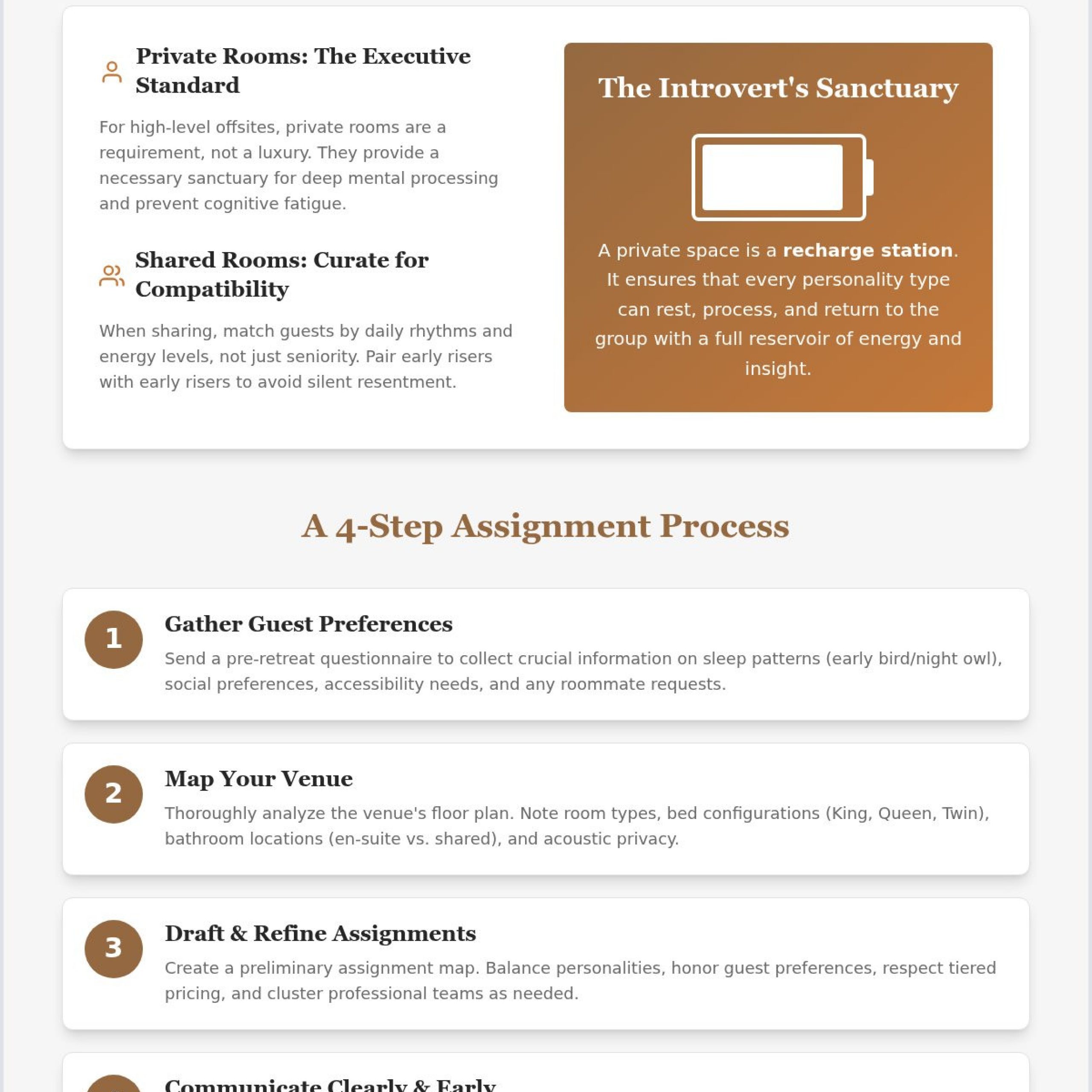
Successful retreats thrive on a delicate equilibrium. While the goal is collective growth, the catalyst is often individual reflection. One of the most critical retreat room assignment tips involves acknowledging the “Introvert’s Tax.” For high-level executive offsites, private rooms aren’t a luxury; they’re a requirement for deep mental processing. When forced into constant social performance without a private door to close, introverted participants experience cognitive fatigue. This diminishes their ability to contribute meaningfully to the group’s success. By providing private quarters, you ensure that every participant returns to the common table with a full reservoir of energy. For those looking for an upscale venue that naturally supports this need for solitude, you can discover Heron Villa, a luxurious four-bedroom rental in Central Florida.
In cases where shared accommodations are necessary, the strategy shifts toward compatibility in daily rhythms. Group participants by energy levels rather than just professional seniority. Pairing an early riser who practices sunrise yoga with a night owl who thrives on late-evening brainstorming is a recipe for silent resentment. Instead, match roommates based on their natural sleep patterns. You might also consider the “Introvert-Extrovert” balance. Pairing a high-energy extrovert with a more grounded, quiet personality can sometimes stabilize the room’s dynamic, provided both guests have a clear understanding of the shared space boundaries.
Creating Sanctuaries for Reflection
Acoustic privacy is a cornerstone of the guest experience, particularly in wellness or executive development contexts where vulnerability is required. In multi-day teacher training intensives, the lack of individual space can lead to emotional exhaustion. For a deeper look at creating the ideal environment, see our guide on A Sanctuary for the Soul. When bedrooms remain true sanctuaries, participants feel safe to decompress completely. This allows common areas to serve as the “Community” anchor, where the group gathers by choice rather than by lack of options.
Fostering Natural Connection Points
Villa-style layouts offer a unique advantage by creating “micro-communities” within a larger group. Instead of a sterile hotel corridor, a shared suite lounge allows for low-pressure, organic interaction. This structure supports the privacy-community balance by providing a middle ground between the isolation of a bedroom and the intensity of a large group session. Strategic placement of leaders and facilitators is also vital; they should be accessible in these common areas during the day but assigned to quiet wings at night to ensure they remain rested. This thoughtful curation of private estate accommodations turns the physical environment into a silent partner in your retreat’s success. It ensures that every guest feels cared for, allowing the group to bond at a pace that feels natural and unforced.
Mapping Your Venue: Room Types and Furniture Configurations
To orchestrate a seamless experience, you must look beyond the guest list and study the physical anatomy of your venue. A detailed floor plan is your most valuable asset. It should reveal more than just room numbers; you need to know exact bed configurations and the specific path to each bathroom. Distinguishing between a “Private Ensuite” and a “Shared Bath” setup is essential for managing expectations before the first suitcase is unpacked. As you evaluate the property’s flow, consider the distance between the primary meeting areas and the sleeping quarters. Ideally, your most active zones should be physically separated from quiet wings to protect the sanctuary-like quality of the bedrooms. Identifying “Flex Rooms” that can transition from a single king to two twin beds allows you to adapt your layout based on final registration numbers, ensuring your retreat room assignment tips remain practical and scalable.
Shared vs. Private Accommodations
Understanding the nuance between lodging tiers is vital for both guest comfort and your bottom line. A “Shared Private” arrangement, where a guest has a solo bedroom but shares a hallway bath, offers a middle ground that many budget-conscious professionals appreciate. This differs significantly from a “True Shared” room where participants share the actual sleeping quarters. To ensure your retreat remains profitable, price these tiers according to the level of privacy provided. When managing shared rooms, your intake form must address practicalities like snoring or the use of CPAP machines. Pairing light sleepers with heavy snorers is a guaranteed way to lower your satisfaction scores. Grouping guests with similar nocturnal habits preserves the peace and ensures everyone wakes up refreshed for the day’s curriculum.
Evaluating Accessibility and Special Needs
True hospitality requires looking beyond standard ADA requirements to consider the lived experience of every guest. In historic or ranch-style properties, limited mobility can be a significant hurdle if not planned for in advance. Check for gravel paths, high door thresholds, or steep stairs that might pose challenges. Guests with specific medical or dietary needs often feel more secure when placed in close proximity to exits and kitchens. This provides them with easy, discreet access to necessary supplies or a quick route to their room if they feel overwhelmed. Additionally, ensure that facilitators or hosts are assigned a central location. This placement allows them to remain a visible, grounding presence while ensuring they are reachable for any 24/7 emergency needs without sacrificing their own restorative sleep.
The Step-by-Step Logistics of Assigning Retreat Rooms
The transition from a theoretical guest list to a functional rooming chart is where your vision meets operational reality. Effective retreat room assignment tips often center on a disciplined timeline that respects both the guest’s anticipation and the venue’s preparation. You shouldn’t wait until the week of arrival to begin this puzzle. Instead, aim to draft a preliminary map at least 30 days out. This gives you ample time to identify gaps in your lodging tiers or potential roommate conflicts before they become urgent. Finalizing the list seven days before arrival allows your venue’s Guest Relations manager to prepare keys and welcome materials with precision. This methodical approach transforms a potential source of stress into a seamless extension of your hospitality.
Gathering Data Through Registration Forms
Your registration form is the most powerful tool for proactive curation. To avoid arrival-day surprises, you must collect critical data during the initial signup phase. Essential questions include gender identity, typical sleep schedules, and specific roommate requests. For groups where participants don’t know each other, a brief “Personality Snapshot” can be invaluable. Ask guests to describe their social battery or their preference for morning quietude. This data allows you to match strangers with a high degree of compatibility. For a complete list of what to clarify with your site, consult our Essential Questions to Ask a Retreat Venue guide. Gathering these details early ensures that every guest feels seen and respected from the moment they book.
Managing Last-Minute Changes
Even the most meticulously planned rooming chart must withstand the reality of last-minute changes. A “Maintenance Pivot” plan is essential. Always prepare for the possibility of a sudden room outage or a guest cancellation. One of the most effective strategies is the “Buffer Room” approach. If your budget and venue capacity allow, keep one unit unassigned. This extra space serves as an emergency relief valve for unexpected maintenance issues or high-priority room-swap requests. When changes occur, communicate immediately with the venue’s housekeeping staff. This ensures their turnover schedule remains synchronized with your new assignments. Handling a guest’s request for a different room gracefully is much easier when you have a physical backup plan ready to deploy.
Coordinating these logistics becomes significantly simpler when you partner with a venue that understands the unique needs of group gatherings. Before you begin outreach to potential properties, using a professional retreat venue RFP template ensures every property receives the same detailed brief about your rooming requirements and group needs. If you’re ready to host your next event in a space designed for both connection and tranquility, explore our private estate rentals to see how we can support your vision.
Elevating the Experience with Private Estate Hosting
Choosing a private estate transforms the logistical puzzle of rooming into a curated hospitality experience. While hotels often offer sterile, standardized corridors, a private villa provides a “home-away-from-home” atmosphere that instantly lowers a guest’s guard. The architecture of these properties mirrors the rhythm of a thoughtful conversation. It moves effortlessly between vibrant communal spaces and quiet alcoves for reflection. Shared living rooms serve as warm, communal anchors where coffee is sipped and ideas are traded, while the bedrooms remain tucked away as quiet sanctuaries. A private buyout at an exclusive use venue secures a boundary for your group’s focus. You won’t find yourself competing with the clatter of a hotel lobby or the presence of strangers in the hallway. This exclusivity allows you to refine your retreat room assignment tips by utilizing every corner of the property to serve your specific group goals.
The Boutique Advantage of Private Villas
Heritage architecture does more than provide a roof; it offers a profound sense of place and history. Staying in a property with a story to tell enriches the guest’s journey, making the retreat feel like a significant event rather than just another meeting. Boutique estates also provide access to a dedicated onsite host who understands the nuances of group dynamics. This steward of the property acts as your partner, ensuring that every detail, from the thread count to the lighting, aligns with your vision. You’ll find that these properties allow for higher levels of customization in room setups, from moving furniture to accommodate specific needs to adding personalized touches that reflect your brand. To see how these spaces come to life, you can explore Solana Spanish Villas’ diverse property options for your next buyout.
Streamlining Coordination with Your Venue Host
The most effective way to visualize your layout is through a physical site visit. Walking the grounds allows you to feel the transition between vibrant community spaces and the hushed quiet of the sleeping wings. Your venue host is an invaluable resource during this phase. They possess an intimate knowledge of the property, knowing exactly which rooms offer the most scenic sunrise views or which are shielded from the morning bustle of the kitchen. Leveraging this local expertise helps you place your guests with a level of precision that a digital floor plan alone cannot provide. They can guide you on which rooms are best suited for your facilitators and which offer the most privacy for your high-level executives. If you’re ready to create a flawlessly executed gathering in a setting that inspires, contact us to plan your executive offsite and discover the difference a dedicated private estate can make.
Designing the Sanctuary Your Group Deserves
The energy of your retreat is quietly shaped by the space your guests call home. By moving beyond simple logistics and embracing these retreat room assignment tips, you create an environment where privacy and community coexist in perfect harmony. You now have the framework to map your venue with precision, manage the nuances of shared accommodations, and leverage the unique advantages of a private estate buyout. It’s this level of intentionality that transforms a standard stay into a deeply restorative journey for every participant.
Solana Spanish Villas specializes in hosting intimate 10-30 person retreats within our boutique heritage properties. We blend old-world charm with modern amenities. Our team provides dedicated event hosting support to ensure your logistics run flawlessly. You’ll find that when every guest feels their personal sanctuary was thoughtfully curated, collective breakthroughs follow naturally. Explore Private Estate Options for Your Next Group Retreat and begin crafting an experience that your participants will cherish. Your next successful gathering starts with the perfect floor plan.
Frequently Asked Questions
How do I handle roommate requests if one person is a snorer?
Address this proactively during the intake process by asking guests about their sleep habits. It’s best to group snorers together or pair them with very heavy sleepers who won’t be disturbed. If your venue layout allows, suggest a private room upgrade for chronic snorers. This ensures that every participant wakes up refreshed and ready for the day’s agenda without lingering nighttime resentment.
Should I charge more for a private room at a wellness retreat?
Yes, your pricing tiers should always reflect the level of privacy and square footage provided. Private rooms are often viewed as high-value sanctuaries, especially during emotionally intense wellness programs. Charging a premium for these quarters helps balance the costs of a exclusive use venue Tucson private estate buyout. It also allows guests to choose the level of investment that matches their personal need for solitude and restoration.
What is the best way to collect roommate preferences during registration?
Utilize a digital registration form that includes specific fields for roommate names, gender identity, and sleep schedules. This is one of the most effective retreat room assignment tips because it captures essential data before the planning phase begins. Include a brief section for a “Personality Snapshot” so you can match solo travelers based on their social energy levels and morning routines.
How do I assign rooms if I have an odd number of participants?
You can offer the final spot as a “single supplement” private room for an additional fee to cover the extra space. Another option is to utilize a larger suite with multiple beds that can comfortably accommodate a group of three. Boutique estates with versatile floor plans make these odd-numbered configurations much easier to manage while still maintaining a high standard of professional hospitality.
Can I change room assignments after the guests have arrived?
Assignments should remain fixed unless a physical maintenance issue or a severe personality clash arises. If a swap is truly necessary, coordinate immediately with your venue host to ensure housekeeping is synchronized. Keeping one “buffer room” unassigned is a brilliant strategic move. It allows you to handle these rare, high-priority requests with grace and minimal disruption to the rest of the group.
Is it better to group people by department or mix them up for a corporate retreat?
Mixing departments is generally better for breaking down professional silos and fostering cross-functional synergies. However, you should still pair roommates based on similar seniority levels or nocturnal habits to ensure comfort. This intentional blending encourages organic networking in shared villa lounges. It turns the physical layout into a tool for building new connections that last long after the retreat concludes.
What should I do if a guest is unhappy with their assigned roommate?
Listen to the guest’s concerns in a private setting and assess if your buffer room is available for a move. If the venue is at full capacity, help the roommates establish clear boundaries for their shared space. Most of these situations can be prevented by following detailed retreat room assignment tips during the intake phase to ensure that pairings are compatible from the very start.
How far in advance should I finalize the retreat rooming list?
Aim to finalize your rooming list at least seven days before arrival. This gives the venue’s guest relations team ample time to prepare personalized welcome materials and specific furniture configurations. You should start drafting your preliminary map 30 days out. This early start allows you to identify any missing data or special accessibility needs well before the final deadline.
0 Comment